There are a lot of measurements to take during the seating evaluation. Do you have suggestions or strategies to make it more efficient?
Answer
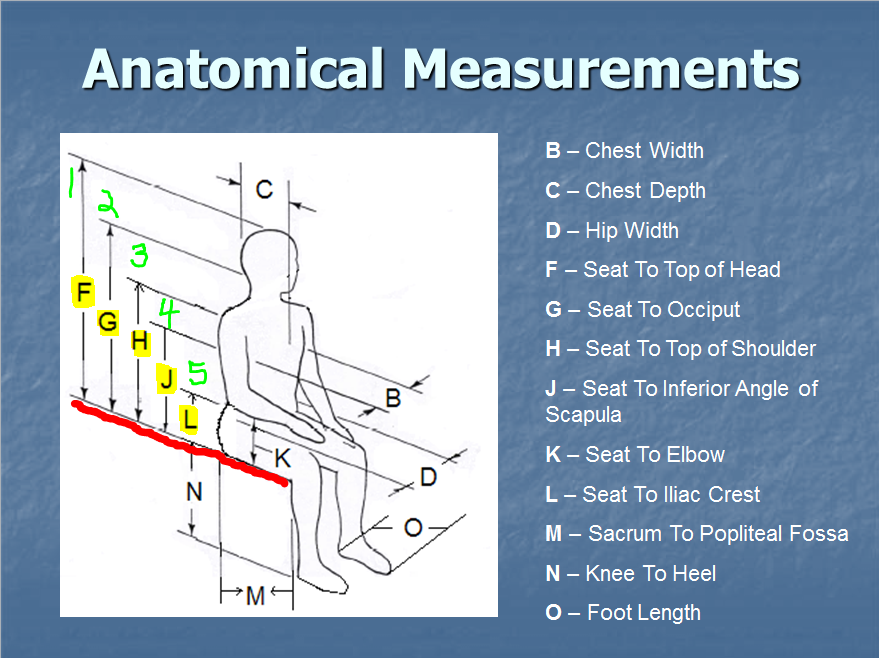
Yes, there are five of the anatomical measurements that can be performed in succession without removing the actual tape from the individual. See measurements FGHJL in the figure below. You will need an assistant who can write down measurements as you call them out. Start with the beginning of the measuring tape resting on the client’s seat and extend the tape up to the top of their head to obtain the "seat to top of head" measurement. Next, keep the beginning of the tape resting on the seat and move the top of the tape down to the occiput at the base of the skull to obtain the "seat to occiput" measurement. Then you can take the "seat to top of shoulder" measurement by sliding the tape to the acromion process. You will then take the "seat to the inferior angle” of the scapula measurement. Be careful with this measurement as you may need to palpate or ask the client to extend their humerus to cause the scapula to wing to find out where that inferior angle is. Still with the beginning of the measuring tape on the client’s seat, the final measurement is the "seat to the top of the iliac crest.” You can go through those five measurements fairly quickly by not moving the beginning of the tape and just starting at the top of the head, then sliding the tape down to the occiput, to the shoulder, the scapula, and the iliac crest. This strategy is helpful in terms of efficiency due to faster measuring, but also less human error. By minimizing the number of times you apply and reapply the measuring tape, the risk for human error will be reduced also.
Editor’s note: This Ask the Expert was adapted from the course, ‘Performing a Successful Seating and Mobility Evaluation’ that is available in text, video and audio course formats.
Kirsten Davin, OTD, OTR/L, ATP, SMS
Dr. Kirsten Davin is a veteran Occupational Therapist of nearly 20 years, with extensive experience in a variety of practice settings including inpatient rehabilitation, acute care, intensive care, and the Central Illinois Regional Burn Center. Since initially obtaining her bachelor’s in occupational therapy in 2001, followed by her post-professional OT Doctorate (OTD) in 2007, Kirsten has served not only as a clinician but also in the role of a clinical consultant specializing in product design and development. Kirsten has fabricated hundreds of splints within her acute care and clinical consulting career, many of which were custom fabricated and individually designed on a case-by-case basis. Her splinting experience ranges from a standard safe position and resting hand splints to highly intricate dynamic splints for the hand, wrist, lower extremities, and cervical spine, incorporating all varieties of materials and splinting medium.
For more than a decade, she has been best known for her live, national speaking tours, which to date have reached over 20,000 therapists in 46 states. She has conducted thousands of educational events on the topics of seating/positioning, assistive technology, work-life balance, acute care/ICU rehabilitation, splint fabrication, orthotic application, and more. Dr. Davin is an engaging speaker who strives to make learning fun.
Related Courses
1https://www.occupationaltherapy.com/ot-ceus/course/navigating-journey-ot-s-role-6393Navigating The Journey: OT’s Role In Oncology And Navigating End-of-Life CareHow clinicians can successfully evaluate and treat clients in oncology rehabilitation throughout the continuum of care will be addressed in this course. Therapists will benefit from building their oncology rehabilitation expertise through current evidence, comprehensive intervention methods, case studies, and specific guidance for clients with various cancer diagnoses. A specialized focus on therapy’s role in end-of-life care will be provided.auditory, textual, visual129USDSubscriptionUnlimited COURSE Access for $129/yearOnlineOnlyOccupationalTherapy.comwww.occupationaltherapy.comNavigating The Journey: OT’s Role In Oncology And Navigating End-of-Life CareHow clinicians can successfully evaluate and treat clients in oncology rehabilitation throughout the continuum of care will be addressed in this course. Therapists will benefit from building their oncology rehabilitation expertise through current evidence, comprehensive intervention methods, case studies, and specific guidance for clients with various cancer diagnoses. A specialized focus on therapy’s role in end-of-life care will be provided.6393OnlinePT60M
'A lot of critical information provided'Read Reviews
AOTA/0.1 Intermediate, OT Service Delivery, Foundational Knowledge, 09463; CE Broker/1.0 CE Broker #20-1209730; IACET/0.1; NBCOT PDUs/1.25 Intermediate, Rehabilitation
How clinicians can successfully evaluate and treat clients in oncology rehabilitation throughout the continuum of care will be addressed in this course. Therapists will benefit from building their oncology rehabilitation expertise through current evidence, comprehensive intervention methods, case studies, and specific guidance for clients with various cancer diagnoses. A specialized focus on therapy’s role in end-of-life care will be provided.
2https://www.occupationaltherapy.com/ot-ceus/course/successful-splinting-foundations-part-1-4768Successful Static Splinting: Foundations, Part 1Following a brief overview of the history of splint fabrication and the advances in the splinting and orthotics arena, an anatomical review of hand structures and landmarks will be performed. Types of splints as well as the variety in thermoplastic materials and characteristics will be presented in preparation for additional courses within this series. This course is Part 1 of a 4-part series on static splinting.auditory, textual, visual129USDSubscriptionUnlimited COURSE Access for $129/yearOnlineOnlyOccupationalTherapy.comwww.occupationaltherapy.comSuccessful Static Splinting: Foundations, Part 1Following a brief overview of the history of splint fabrication and the advances in the splinting and orthotics arena, an anatomical review of hand structures and landmarks will be performed. Types of splints as well as the variety in thermoplastic materials and characteristics will be presented in preparation for additional courses within this series. This course is Part 1 of a 4-part series on static splinting.4768OnlinePT60M
AOTA/0.1 Introductory, Foundational Knowledge, 12096; CE Broker/1.0 Home Study, General (FL), Patient Related (AL), General Continuing Education (GA), Direct Client/patient Services In Occupational Therapy (SC), Related To OT (AZ), Related To OT (LA), Directly Related To OT (MS), Directly Related To OT (TN), CE Broker #20-707885; IACET/0.1; NBCOT PDUs/1.25 Beginner, Rehabilitation
Following a brief overview of the history of splint fabrication and the advances in the splinting and orthotics arena, an anatomical review of hand structures and landmarks will be performed. Types of splints as well as the variety in thermoplastic materials and characteristics will be presented in preparation for additional courses within this series. This course is Part 1 of a 4-part series on static splinting.
3https://www.occupationaltherapy.com/ot-ceus/course/successful-static-splinting-forearm-based-4785Successful Static Splinting: Forearm Based Splint Fabrication, Part 2In this course, types of pre-cut, pre-formed and sheet-based splint fabrication techniques are explored as well as a comparison between volar and dorsal-based approaches. A detailed demonstration of four types of forearm-based wrist orthotics are presented, including radial gutter/thumb spica splints, dorsal and volar wrist cock-ups, and functional position with an intrinsic plus modification option. This course is Part 2 of a 4-part series on static splinting.auditory, textual, visual129USDSubscriptionUnlimited COURSE Access for $129/yearOnlineOnlyOccupationalTherapy.comwww.occupationaltherapy.comSuccessful Static Splinting: Forearm Based Splint Fabrication, Part 2In this course, types of pre-cut, pre-formed and sheet-based splint fabrication techniques are explored as well as a comparison between volar and dorsal-based approaches. A detailed demonstration of four types of forearm-based wrist orthotics are presented, including radial gutter/thumb spica splints, dorsal and volar wrist cock-ups, and functional position with an intrinsic plus modification option. This course is Part 2 of a 4-part series on static splinting.4785OnlinePT60M
'Some of the test questions were confusing'Read Reviews
AOTA/0.1 Intermediate, OT Service Delivery, Foundational Knowledge, 12097; CE Broker/1.0 Home Study, General (FL), Patient Related (AL), General Continuing Education (GA), Direct Client/patient Services In Occupational Therapy (SC), Related To OT (AZ), Related To OT (LA), Directly Related To OT (MS), Directly Related To OT (TN), CE Broker #20-785684; IACET/0.1; NBCOT PDUs/1.25 Intermediate, Orthopedics
In this course, types of pre-cut, pre-formed and sheet-based splint fabrication techniques are explored as well as a comparison between volar and dorsal-based approaches. A detailed demonstration of four types of forearm-based wrist orthotics are presented, including radial gutter/thumb spica splints, dorsal and volar wrist cock-ups, and functional position with an intrinsic plus modification option. This course is Part 2 of a 4-part series on static splinting.
4https://www.occupationaltherapy.com/ot-ceus/course/successful-splinting-series-hand-based-4814Successful Static Splinting: Hand Based Splint Fabrication, Part 3Types of pre-cut, pre-formed and sheet-based splint fabrication techniques are explored as well as video demonstration of the fabrication of a hand-based thumb spica, finger gutter and MP joint blocking splints. In addition, the application and use of a spring finger extension splint, oval 8 splints as well as static progressive finger flexion and extension splints are discussed.auditory, textual, visual129USDSubscriptionUnlimited COURSE Access for $129/yearOnlineOnlyOccupationalTherapy.comwww.occupationaltherapy.comSuccessful Static Splinting: Hand Based Splint Fabrication, Part 3Types of pre-cut, pre-formed and sheet-based splint fabrication techniques are explored as well as video demonstration of the fabrication of a hand-based thumb spica, finger gutter and MP joint blocking splints. In addition, the application and use of a spring finger extension splint, oval 8 splints as well as static progressive finger flexion and extension splints are discussed.4814OnlinePT60M
'Wording and double negative questions were often confusing'Read Reviews
AOTA/0.1 Intermediate, OT Service Delivery, Foundational Knowledge, 12098; CE Broker/1.0 Home Study, General (FL), Patient Related (AL), General Continuing Education (GA), Direct Client/patient Services In Occupational Therapy (SC), Related To OT (AZ), Related To OT (LA), Directly Related To OT (MS), Directly Related To OT (TN), CE Broker #20-711131; IACET/0.1; NBCOT PDUs/1.25 Intermediate, Rehabilitation
Types of pre-cut, pre-formed and sheet-based splint fabrication techniques are explored as well as video demonstration of the fabrication of a hand-based thumb spica, finger gutter and MP joint blocking splints. In addition, the application and use of a spring finger extension splint, oval 8 splints as well as static progressive finger flexion and extension splints are discussed.
5https://www.occupationaltherapy.com/ot-ceus/course/successful-splinting-series-static-splint-4838Successful Static Splinting: Fabrication for Specific Diagnoses, Part 4Types of pre-cut, pre-formed and sheet-based splint fabrication techniques are explored as well as instruction on the fabrication of a foot plate for external fixator application, the application of lower extremity splints and orthotics as well as splinting considerations for specific diagnoses including burn injury. A focus on creative splinting techniques is emphasized.auditory, textual, visual129USDSubscriptionUnlimited COURSE Access for $129/yearOnlineOnlyOccupationalTherapy.comwww.occupationaltherapy.comSuccessful Static Splinting: Fabrication for Specific Diagnoses, Part 4Types of pre-cut, pre-formed and sheet-based splint fabrication techniques are explored as well as instruction on the fabrication of a foot plate for external fixator application, the application of lower extremity splints and orthotics as well as splinting considerations for specific diagnoses including burn injury. A focus on creative splinting techniques is emphasized.4838OnlinePT60M
AOTA/0.1 Intermediate, OT Service Delivery, Foundational Knowledge, 12099; CE Broker/1.0 Home Study, General (FL), Patient Related (AL), General Continuing Education (GA), Direct Client/patient Services In Occupational Therapy (SC), Related To OT (AZ), Related To OT (LA), Directly Related To OT (MS), Directly Related To OT (TN), CE Broker #20-713075; IACET/0.1; NBCOT PDUs/1.25 Intermediate, Rehabilitation
Types of pre-cut, pre-formed and sheet-based splint fabrication techniques are explored as well as instruction on the fabrication of a foot plate for external fixator application, the application of lower extremity splints and orthotics as well as splinting considerations for specific diagnoses including burn injury. A focus on creative splinting techniques is emphasized.